
Every claim pre-coded before a human touches it.
Coding Studio is where Chart.ai's coding output lands. When Chart.ai reads the full history, the suggested codes, confidence scores and evidence arrive in Coding Studio for an expert coder to accept or reject. Coding Studio stands on its own inside RCM.ai, and it is also the front end for Chart.ai's codes.
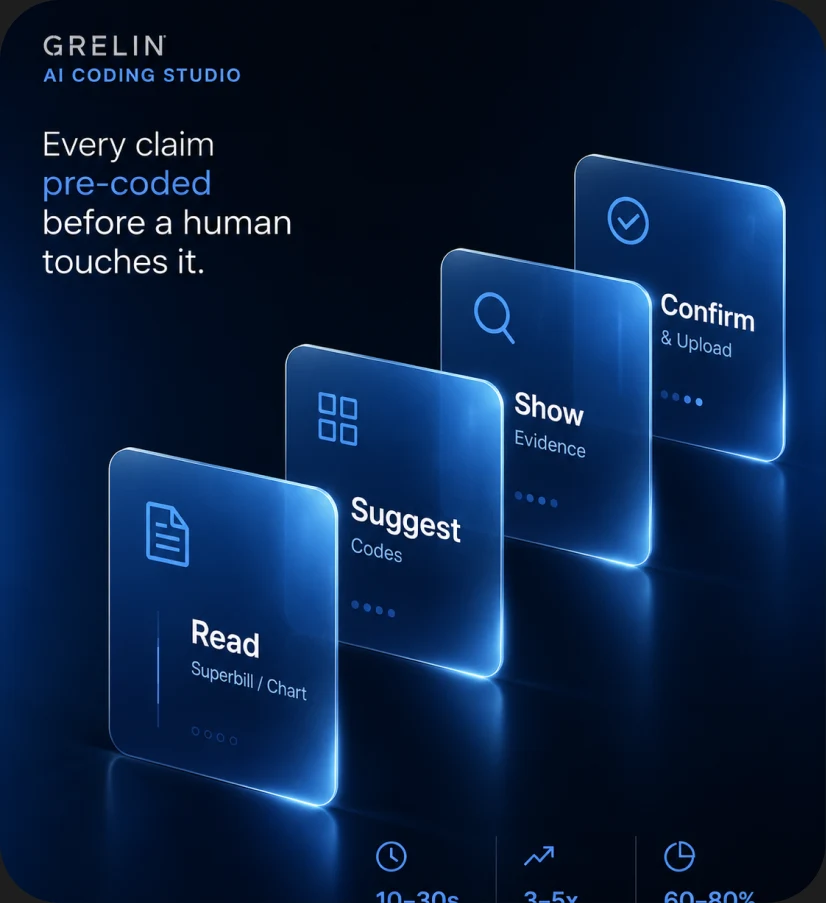
Coding Studio reads the superbill or chart, suggests codes and shows evidence in 10 to 30 seconds. Your coders confirm, and the claim uploads straight to billing.
10–30s
Per claim engine speed
3–5x
Coder throughput
60–80%
Less manual effort
Encounter #90481 CLM-90481
Outpatient Cardiology Visit
Specialty: Cardiology · Payer Mix: Medicare Outpatient
Clinical chart & documentation
Ingested from PMS/EHR · Encounter note
EXAM & PLAN:
Patient is a 64-year-old male returning for routine cardiology follow-up.
Vital signs: BP 142/88, HR 72.
Current medications: Lisinopril 10mg daily, Atorvastatin 20mg daily.
Laboratory results reviewed: Lipid panel LDL 135.
12-lead ECG performed today demonstrating normal sinus rhythm.
MDM is moderate complexity based on management of multi-system chronic conditions.
AI Pre-processed: 10 to 30 seconds vs Manual processing: 5 - 6 mins
Engine Confidence 98%Drafted in 10 to 30s (Ready for Expert Review) Pre-assigned
Suggested ICD-10 codes
Essential (primary) hypertension
Evidence: “Patient presents with persistent BP 142/88 mmHg on exam.”
Hyperlipidemia, unspecified
Evidence: “Lipid panel shows LDL 135 mg/dL. Statin regimen managed.”
Suggested CPT codes & required modifiersRule Logic Applied
Office or other outpatient visit for E/M (Established, Moderate complexity)
Medical decision making of moderate complexity with 2 stable chronic illnesses.
Electrocardiogram, routine ECG with at least 12 leads; with interpretation & report
12-lead ECG performed in clinic. Normal sinus rhythm with early repolarization.
Coding Rationale · Compliance & Denial Risk (Low 1.2%)
Payer Rule: Modifier 25 verified — distinct procedural service documented in encounter note section 3.
What actually happens
Coding Studio runs three stages: Extraction, AI Accelerated Coding, Automated Billing.
Extraction
Work enters however it exists: extract a superbill, upload a chart or paste one in. The extraction layer reads it either way.
SUPERBILL, CHART PDF, OR RAW TEXT INGESTION
AI Accelerated Coding
Everything goes through the coding.ai engine. In 10 to 30 seconds the coder has suggested codes, a confidence score on each one, the chart evidence that supports it and any compliance flags that need attention.
10–30S PROCESSING · CODES · CONFIDENCE · RATIONALE
Automated Billing
Once the coder confirms the codes, the claim uploads automatically to Office Ally for billing. No re-keying, no export step.
DIRECT UPLOAD TO OFFICE ALLY · ZERO RE-KEYING
"The coder's job changes from building the code set to verifying it. That is the whole product."
Modeled Impact & Throughput Benchmarks
Time per claim.
SIMPLE OUTPATIENT CLAIM
97% ReductionA simple claim pre-processes in 10 to 30 seconds with suggested codes, confidence scores, evidence, and compliance flags ready for review.
COMPLEX SPECIALTY CLAIM
95–97% ReductionComplex claims receive full AI pre-processing in 10 to 30 seconds, reducing manual chart search and code set assembly time.
Headcount & Capacity
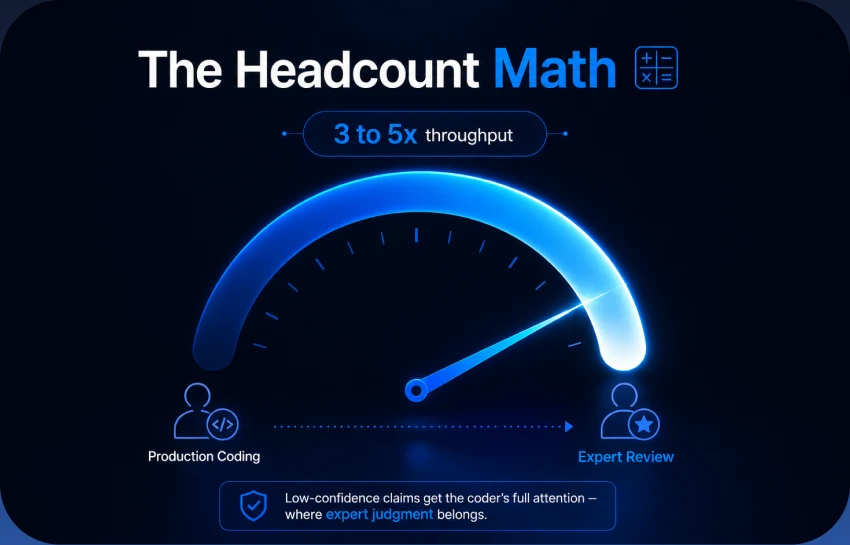
Redeploy production coding labor to expert review. Achieve 3 to 5x throughput without adding headcount.
Low-confidence claims get the coder's full attention — where expert judgment belongs.
Augmentation, stated plainly
Coding Studio does not replace coders. Expert coders review and approve every claim.
What it removes is the manual part: reading the full chart cold, searching code sets, cross-checking payer rules by hand.
Per-Coder Performance Results
The results per coder:60 to 80% less manual effort per claim.
3 to 5x throughput without adding headcount.
High-confidence claims move fast. Low-confidence claims get the coder's full attention. That is where expert judgment belongs.
Built for teams that code at volume.
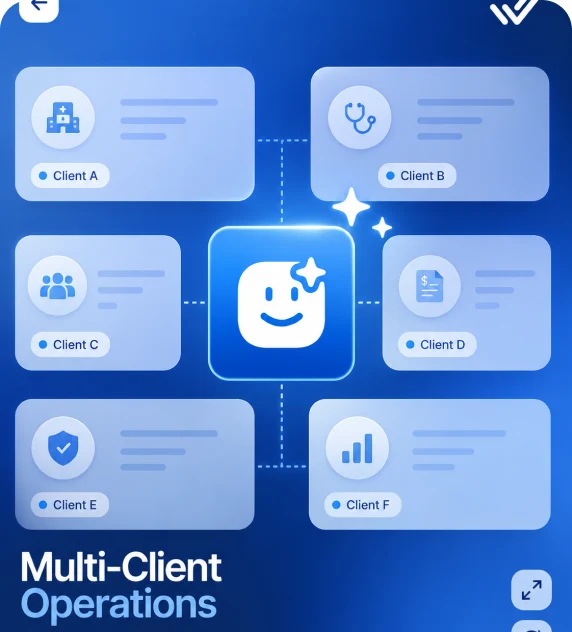
RCM billing companies.
Coding across many client systems, specialties, and payer mixes.
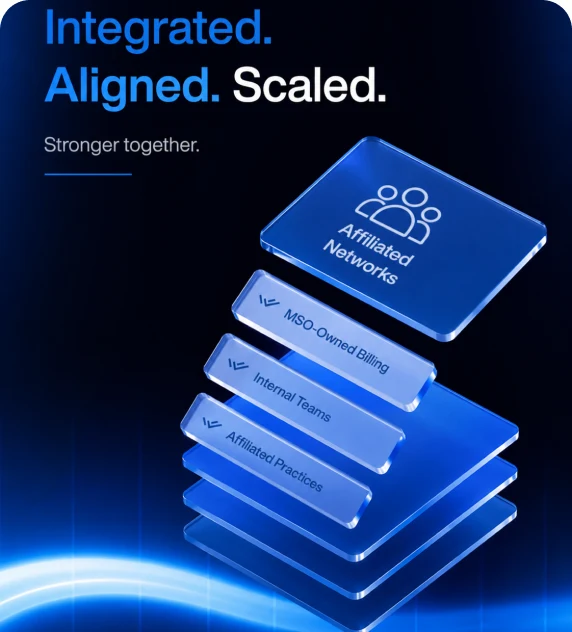
MSO-owned billing operations.
Internal teams coding for affiliated practices.

Specialty practices and health systems.
High-complexity case mix where coding accuracy drives revenue.
Where it sits in the suite
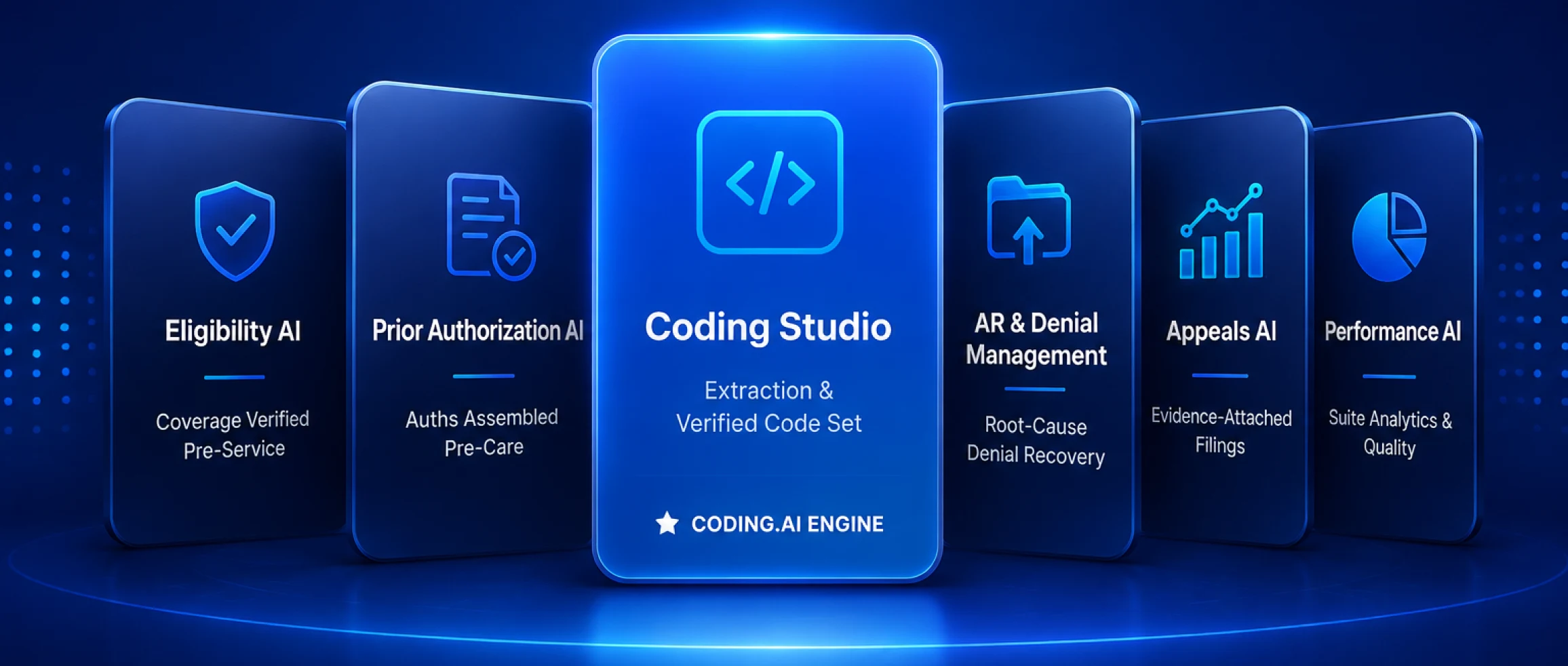
Coding Studio is the coding module of RCM.ai, one of six: Eligibility AI, Prior Authorization AI, Coding Studio, AR & Denial Management, Appeals AI and Performance AI.
It covers the middle of the lifecycle end to end. Extraction reads the superbill or chart, the coding.ai engine builds the code set and the confirmed claim uploads automatically for billing.
Implementation
PHASE 1 · 2 TO 4 WEEKS
Two to four weeksIntegration & Tuning
Connect superbill/chart extraction layers and tune payer-specific rules against your specialty mix.
Extraction setup
Payer & specialty logic tuning
PHASE 2 · 2 TO 3 WEEKS
Two to three weeksShadow coding
Run coding.ai pre-processing against live volume, measuring suggested code accuracy against your coders.
Live shadow volume
Accuracy & review benchmarking
PHASE 3 · 2 TO 3 WEEKS
Two to three weeksProduction go-live
Phase 3. Production go-live with experts reviewing in Coding Studio. Two to three weeks.
Coding Studio production active
Automated billing upload enabled
Full Onboarding Horizon: 6 to 10 Weeks Total
No workflow disruption during Phase 1 integration or Phase 2 shadow coding.
Why this matters at scale
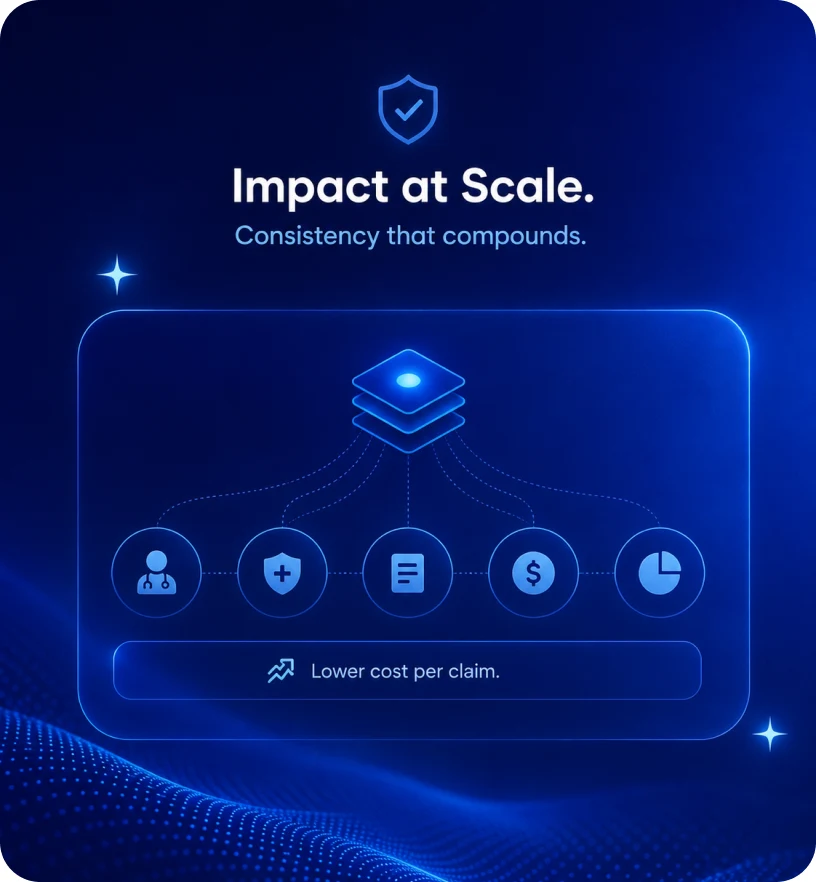
A coding error on one claim is a correction. The same error across 40 specialties and every payer is a denial pattern.
Coding Studio applies the same logic to every claim, every time. Payer-specific rules are enforced at coding, not discovered at denial.
That consistency is what compounds. Lower cost per claim is the only RCM metric that does.
Every claim pre-coded before a human touches it.
See Coding Studio in action on your own charts or speak with our team.
Direct Business Development Inquiry
bizdev@grelinhealth.comCoding Studio
Frequently Asked Questions
How Coding Studio reads the chart, suggests codes with evidence, and uploads confirmed claims to billing.
What is Coding Studio?
Coding Studio is the front end to Grelin's coding.ai engine. It reads a superbill or chart, suggests ICD-10 and CPT codes with the chart evidence behind each one, and returns the result in 10 to 30 seconds. The coder confirms the codes, and the finished claim uploads straight to billing.
How does Coding Studio speed up medical coding?
Coding Studio does the reading and the first-pass code selection, so the coder reviews a ranked suggestion instead of searching the chart. Each suggested code carries a confidence score, the sentence it came from, and any compliance flag. The coder spends their time on judgment, not lookup, which is where coding time is actually lost.
Does Coding Studio replace certified coders?
No. Coding Studio accelerates certified coders rather than replacing them. Every code is a suggestion with evidence attached, and nothing is billed until a coder confirms it. The coder keeps full control of the claim; the tool removes the manual reading and lookup that slow the work down.
How does Coding Studio get work in and claims out?
Work enters however it already exists: extract a superbill, upload a chart, or paste one in. Coding Studio suggests codes with evidence, the coder confirms, and the confirmed claim uploads automatically to the billing system, such as Office Ally. There is no separate export or re-keying step.
What is AI medical coding?
AI medical coding is the use of AI to read clinical documentation and propose the ICD-10 and CPT codes the record supports, with evidence for each code. It differs from autocoding that guesses from a problem list: the codes are tied to specific chart text, and a certified coder confirms them before the claim is billed.
Still have questions?
We're here to help you navigate the complexities of revenue cycle intelligence.